
can we pinpoint happiness in the brain?
pleasure, meaning and engagement - the different types of happiness and where they are found in the brain

I was listening to a podcast the other day and the terms hedonic happiness and … Youdymonic? Eudymonic? Eudaimonic? Eudaemonic happiness came up. After a few google searches I managed to find it. I didn’t even know there was a word for that type of happiness. The fulfilling, meaningful, connected to a larger whole kind. Not the pleasure seeking, quick-reward kind. That’s hedonic happiness. Like you get from eating chocolate.
I’ve often mulled over different people’s journeys towards finding eudaemonic (meaningful) happiness. I’ve often felt like I realised the need for this too early in life. Not early enough to stress too much about my studies and let them take over my life. But early enough to be at the start of building my career and not wanting to sacrifice my (eudaemonic) happiness to work hard at a job I don’t care about before finally earning a life that fulfils me. Now that story I’ve heard repeatedly.
I’ve heard countless interviews with business people who get to 30 (or older), are overworked, rich and successful on paper but not at all fulfilled within. They have an existential crisis and change directions to build a better, more fulfilling life for themselves (with lots more eudaemonic happiness one can only assume) and as we could guess their new path obviously works out for them, given they’re getting interviewed on how they got there. I listen to these stories and firstly think (selfishly) — how do I make a successful life for myself if I’m not willing to sacrifice my happiness for years before getting there? And I also think (less selfishly) — how are we not educated about meaning and purpose (i.e. eudaemonic happiness) earlier in life, and understand that this is a greater need than any other? Although I will disclose I was briefed in Maslow’s hierarchy in a first-year psych subject! Although I’m not sure that suffices.
Aside: apologies about the overuse of the word eudaemonic. I bet you’ve never seen the word before and now you’ve seen it used about 50 times in 3 paragraphs. Well, you know there’s that period after you learn a new word where you need to overuse it to solidify its meaning. There you go, now it’s drilled into my head and yours. Moving on…
As usual with any abstract concept,
one must only search it up on Stanford Encyclopedia of Philosophy to find a fully-fledged debate on the topic.
This of course holds true for happiness. How is it defined? Which theory is most correct? Can it be measured?
… As to the last question, neuroscientists have tried anyway, debate aside. There have been thousands of neuroimaging studies conducted assessing which parts of the brain fire in different types of happiness. Researchers usually focus on testing one specific type of happiness through a specific task. For example, watching comedy or eating sugar elicits hedonic happiness or reflecting on happy memories elicits eudaemonic happiness. But there’s one more type of happiness according to Seligman (a trusted science guy who wrote a book defining happiness in 2002, which researchers tend to use as a framework to study the concept). He adds one more source of happiness — engagement.
Engagement is said to be similar to “flow” wherein a deep focus is achieved in the goal of accomplishing a task (Csikszentmihalyi, 1990). Seligman says that happiness is a state of well-being and satisfaction which can be achieved through these 3 dimensions (hedonic, eudaemonic and engagement).
*
Given that these types of happiness feel so different in experience, I wanted to delve into the neuroimaging research to see if they look different in the brain. It seems Tanzer and Weyandt, researchers from the University of Rhode Island wondered the same thing, but they published a research paper about it. In this paper they analysed a large number of brain imaging studies, separating experiments into the 3 types of happiness — pleasure (hedonic), engagement and meaning (eudaemonic) — to determine which brain regions are involved in each.
It seems it’s not a one-to-one map of brain area to happiness type, and the opposite is also incorrect wherein the same area is not responsible for every type of happiness.
Amongst all happiness types there was a high overlap in brain regions activated — 14 regions were activated in all types (depicted as brown areas in the images below). We can also see that a diverse array of brain regions was activated in happiness experiments (coloured areas), as were the thalamus and claustrum, brain areas that collate and relay information from one area to another. It’s evident that a broad response occurs which synchronises (thanks to these relaying areas) to form our experience of happiness.
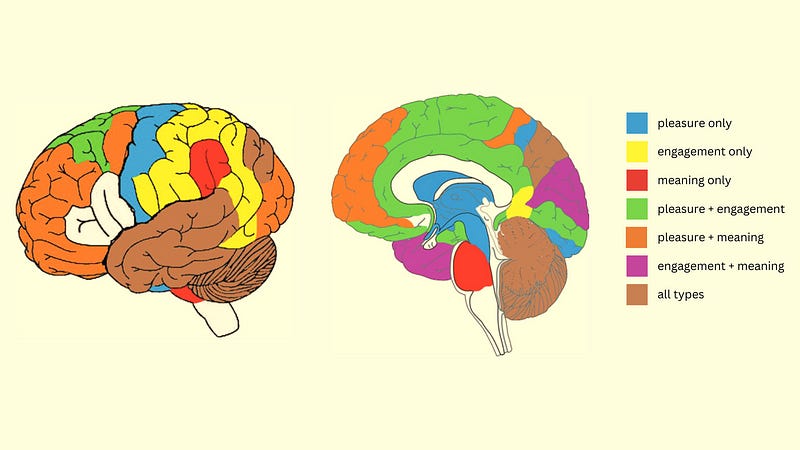
Not only was there widespread activity, there was also generally higher activity in happy brains when compared to controls. Controls are similarly designed experiments that don’t induce happiness which are given to another group of people. No matter the task, no matter the source of happiness, the general neuroactivation in the brain was HIGHER. There was more happening! More synapses, more activity, more connections being made. So, if we find a task pleasant, satisfying/engaging or meaningful, we are likely to stimulate more brain activity when doing it.
Some of the regions activated in all types of happiness were activated more or less in the different types. For example, the basal ganglia (an area involved in movement) was activated in all forms of happiness, but MOST activated in happiness as pleasure. This means that it was more of a key player in pleasure than in engagement or meaning.
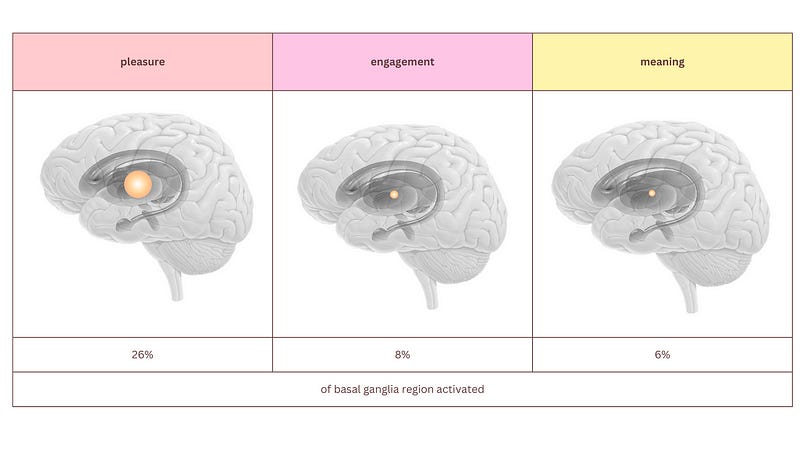
We can compare the percentage of areas activated in different types of happiness to put together a bigger picture. It can shed light on which areas are key players and which are the support roles, sort of like back-up singers.
*
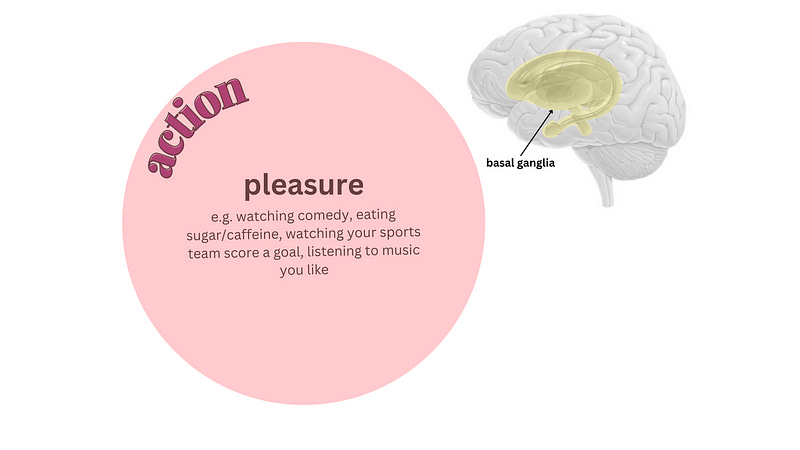
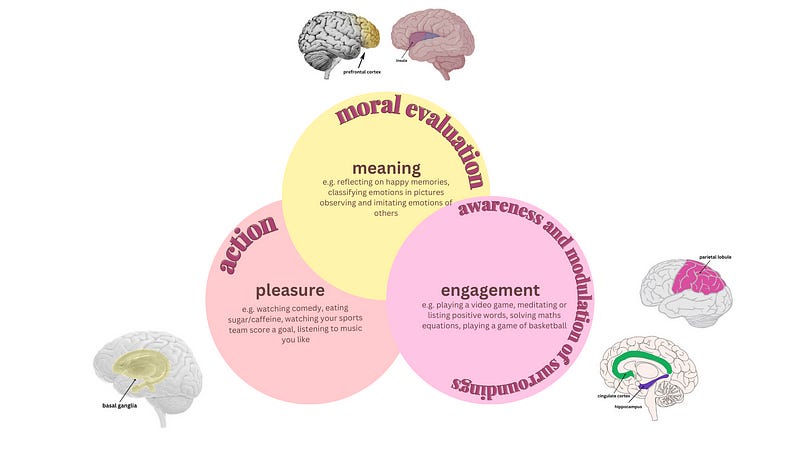
happiness as pleasure:
For happiness as pleasure, the basal ganglia and frontal gyrus — areas involved in movement initiation (i.e. doing) were more active than in other forms of happiness. Additionally, the prefrontal cortex (involved in executive functioning, e.g. stopping yourself from doing things), the parietal lobule and cerebellum (movement planning areas) had more subdued activation than in other forms of happiness.
We can understand this in the context of pleasure seeking. If you are in pursuit of something pleasurable you are quick to act to obtain it, and inhibition often gets thrown out the window. Happiness derived from pleasure involves more doing and less thinking. So acting for pleasure requires less consideration of our surroundings and more readiness to snap into gear and obtain pleasure as quickly as possible.
happiness as engagement:
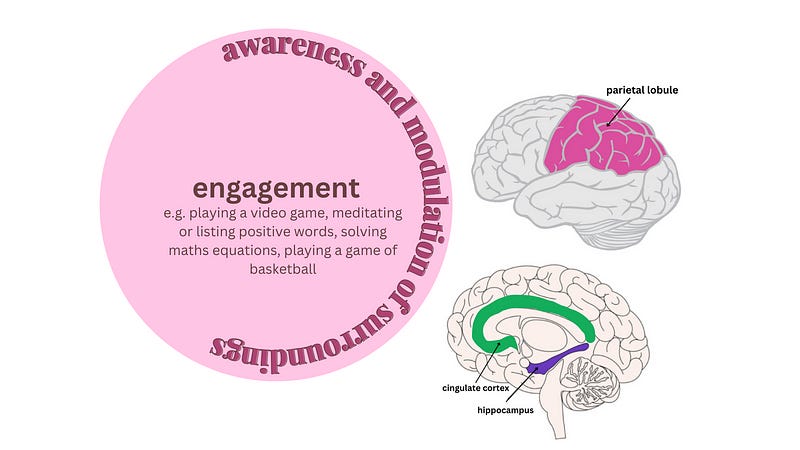
Engagement involved lower activation of movement initiation areas (basal ganglia) than those involved in pleasure but higher activation of the parietal lobule and cerebellum — areas that are involved in coordination and placing oneself in space. Increased activation of the cingulate cortex, a brain region which modulates activity in other brain regions was also found.
Putting this together, engagement involves being aware of the space around you and in turn, knowing what to modulate (or down-regulate) to sustain focus on the task at hand. If you are playing a video game or solving maths equations, you need to be aware of where you fit in your surroundings, in order to know what to block out so you can focus on that specific task.
happiness as meaning:
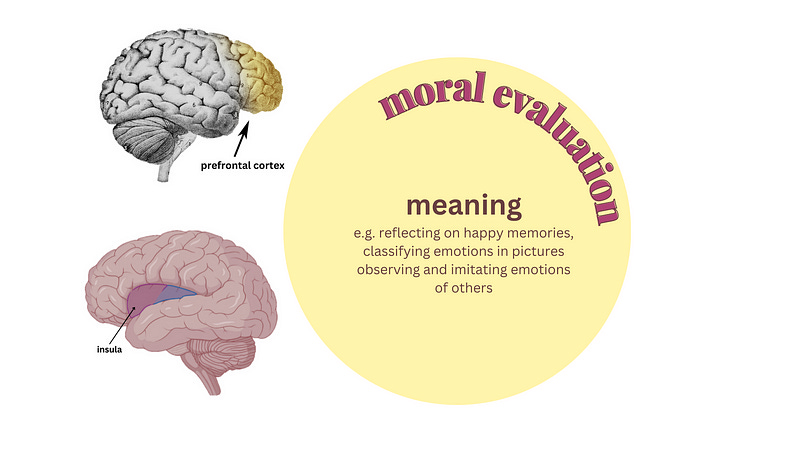
Happiness as meaning involved less activation of brain areas to do with movement, and more activation of areas to do with morality (prefrontal cortex) and evaluation of disgust (insula). When we pursue meaningful happiness, we assess how it is meaningful to us, so increased activity of the moral centre and disgust evaluator are fitting.
It’s less about what you are physically doing to get a hit of happiness, as in pleasure, and more about evaluating whether stimuli morally align with you.
One main difficulty in measuring happiness through experiments, is rooted in the nature of an experiment — giving a task. Many brain regions were activated that could be linked to the task people were doing, and probably had less to do with the “feeling” of being happy. For example, if you are given a visual stimulus then areas of the brain involved in visual processing were activated.
Basically, it’s hard to isolate activation areas that are only linked to the task or only represent the feeling of being happy — and in the end we might not need to separate them at all. Maybe happiness is not just a feeling but a combination of that feeling as a result of the activity we do to pursue happiness. The brain doesn’t process them separately, but together.
All in all, I didn’t feel shocked at the results of the meta-analysis. In context, it makes sense with how we experience the different forms of happiness. Want a quick mood boost? Listen to music, you’re not overthinking or exerting executive function in pursuing this hedonic happiness. Want to figure out what activity aligns with your values? Rifling through jobs or volunteering activities will activate your moral centre whilst evaluating whether they align with you. Ultimately that seems to be the way in science, it usually affirms what we have experienced and defines it in the physical, experimental, labelled world.
*
here’s a little summary if you don’t want to read this whole article!
summary:
happiness increases brain activity
happiness activates diverse brain regions
the brain’s representation of happiness depends on the task you are doing (and possibly the type of happiness you are feeling)
happiness as pleasure is highly linked to movement and doing
happiness as engagement is highly linked to coordination to sustain attention
happiness as meaning is highly linked to moral evaluation
references:
Csikszentmihalyi, M. (1990). Flow: The psychology of optimal experience. New York, NY: Harper and Row Publishers.
Haybron, Dan, “Happiness”, The Stanford Encyclopedia of Philosophy (Summer 2020 Edition), Edward N. Zalta (ed.), URL = <https://plato.stanford.edu/archives/sum2020/entries/happiness/>.
Seligman, M. E. (2002). Authentic happiness: Using the new positive psychology to realize your potential for lasting fulfillment. Simon and Schuster.
Tanzer, J. R., & Weyandt, L. (2020). Imaging happiness: Meta analysis and review. Journal of Happiness Studies: An Interdisciplinary Forum on Subjective Well-Being, 21(7), 2693–2734. https://doi.org/10.1007/s10902-019-00195-7